
Rubber rollers are what most production lines run on: they pull the web, set the nip pressure, meter the coating and drive the belt. When the cover hardens, glazes or loses concentricity, the symptom shows up somewhere else — tracking drift, inconsistent coating weight, edge wrinkles, or a print defect that looks like a plate problem.
This page covers what we can build, how to specify it, and how to tell when a roller needs replacing rather than re-grinding.
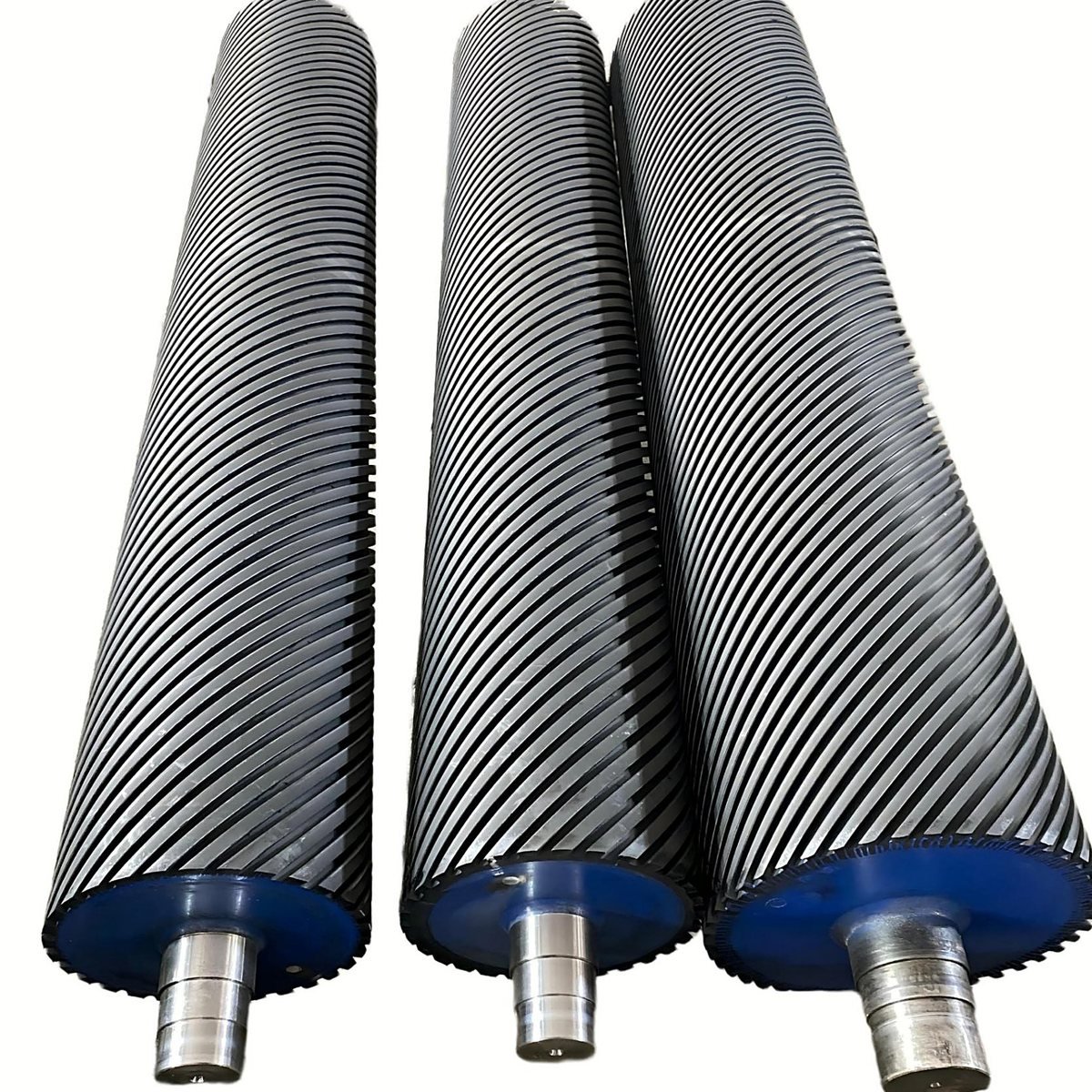
Five Compounds, Five Different Failure Modes
Choosing a compound is not about picking the hardest rubber available. It is about matching the compound to what degrades it on your line.
| Compound | Hardness | Heat resistance | Resists | Avoid when |
|---|---|---|---|---|
| NBR (nitrile) | 30–90 Shore A | to 100 °C | Oils, greases, hydraulic fluid | Strong ozone, sunlight, ketones |
| EPDM | 40–90 Shore A | to 120 °C | Ozone, water, steam, weather | Mineral oils and solvents |
| SBR | 40–90 Shore A | to 80 °C | Abrasion, general wear | Oil contact, high heat |
| Neoprene (CR) | 40–85 Shore A | to 110 °C | Moderate oil, weather, flame | Strong solvents, high heat |
| Silicone | 30–80 Shore A | to 250 °C | Heat, release, sticking | Abrasion, oil, high load |
If your application does not fit any row — food contact, static dissipation, low temperature — say so in the enquiry. Those need a different compound, not a compromise.
Hardness Changes Behaviour More Than Any Other Spec
Hardness drives nip width, contact pressure, grip and how the roller wears. Two rollers with the same diameter but different hardness behave like different parts.
| Hardness | Behaviour | Typical position |
|---|---|---|
| 20–35 Shore A | Very soft, conforms to uneven surfaces, wide nip at low pressure | Film and foil nipping, delicate webs, laminating |
| 40–55 Shore A | Soft to medium, good grip with moderate deflection | Feed rollers, pull rollers, general nip |
| 60–70 Shore A | Medium, the industry default for most web handling | Idler, guide and general conveying |
| 75–85 Shore A | Hard, low deflection, precise nip control | Coating and metering, printing press rollers |
| 90+ Shore A | Very hard, minimal deflection, closest to a steel roller | Squeeze rollers, high pressure nips |
Selection rule of thumb: start from the hardness of the roller you are replacing. If you are replacing it because it failed early, change the compound before changing the hardness.
What We Can Build
Dimensions we quote most often. If your roller falls outside these ranges, send it anyway — the limits depend on core size and grinding capacity.
| Parameter | Range | Notes |
|---|---|---|
| Outside diameter | to be confirmed | Larger diameters quoted individually |
| Face length | to be confirmed | Dependent on core and grinding capacity |
| Cover thickness | 3–25 mm | Thicker covers for recovering worn cores |
| Hardness | 20–95 Shore A | Tolerance typically ±3 Shore A |
| Concentricity / runout | 15 micron | Tighter on request after review |
| Surface finish | Ground, polished, matt, grooved, knurled | Groove pitch and depth as specified |
| Core material | Carbon steel, stainless steel, aluminium | New core or customer’s core |
| Balancing | Static or dynamic on request | Required above certain surface speeds |
The Surface Does Half the Work
Ground
The standard. Flat, consistent contact across the face.
Polished
For coating and metering where surface texture transfers to the web.
Grooved
Longitudinal or spiral grooves release air or liquid at the nip and reduce wrinkling.
Knurled
Mechanical grip for drive rollers and belt contact.
Groove geometry matters more than most buyers expect: pitch, depth and angle control how air escapes at the nip. If you are fighting wrinkles at line speed, that is the first conversation to have.
Where These Rollers Are Used
- Printing — ink, dampening and rider rollers on offset and flexo presses
- Packaging — film nipping, sealing, laminating and carton feed
- Film converting — BOPP, PET, PVC and battery separator lines
- Paper and board — slitting, rewinding, coating and calender stacks
- Textile and nonwoven — padder, squeeze and guide rollers
- Conveying — lagged drive rollers and rubber covered idlers
What We Measure Before Packing
- Durometer hardness, recorded per batch
- Outside diameter and concentricity against the drawing
- Runout measured on centres
- Visual check for voids, blisters, undercut and bonding separation at the core interface
- Dynamic balancing when specified
Rubber Roller Questions
How do I know if my roller needs recovering or replacing?
If the core is sound and the shaft journals are within tolerance, recovering usually costs less and takes less time than a new roller. If the core is bent, corroded or the journals are worn, a new core is the safer route. Send photos and dimensions and we will tell you which one applies.
Can you match the hardness of my existing roller?
Yes, if the existing roller is still within a usable range. Send it or give us a durometer reading taken at several points along the face. Readings at the ends are usually higher than the middle on a worn roller — tell us which reading you want matched.
What tolerance should I specify?
15 micron runout covers most web handling. Printing and coating positions may need tighter. Do not specify tighter than the application needs: it raises cost without improving the result.
Do you supply the core as well?
Yes. We machine new cores in carbon steel, stainless steel or aluminium, or re-cover a core you ship to us.
Can you produce a small trial order?
Yes, from one piece. Many customers start with a single roller for one position before converting a full set.
Send the Drawing or the Worn Roller
Email your drawing, the machine model, or photos of the roller you need replaced. You will get a compound recommendation, a hardness proposal, a price and a lead time.